![3PL Logo White.png]](https://kb.3p-logistics.co.uk/hs-fs/hubfs/3PL%20Logo%20White.png?height=40&name=3PL%20Logo%20White.png)
Contents
Product Information
When creating products within 3PL Fusion, all product information should be correct and accurate. Information requested during setup is requested to ensure you receive the best service and price.
Each product variation should be created as a separate SKU within fusion. For example, if you sell a T-Shirt, then each colour and size variation would have its own unique identifier, as per the below example.
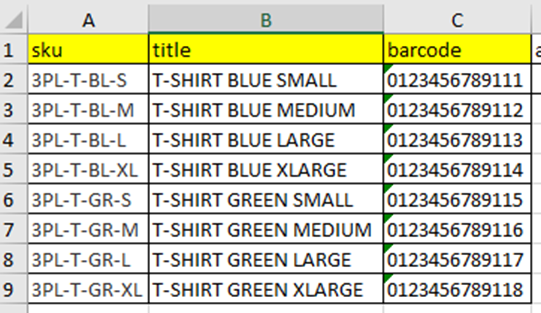
Key Fields
- SKU: The product code is the unique identifier for your product and ideally should match the SKU code set up on your selling channels. Each colour or size variation is treated as a separate SKU.
- Product title & description: This should represent markings that are already on the product, e.g. model or size. If the item is a set or a bundle, then the quantity in the set/bundle should be in the description. e.g. Energiser AA pack of 4.
- Barcodes: CODE128 or EAN formats are recognised by 3PL. Barcodes are used for scanning items during every step of the fulfilment process. This is the main contributor towards accuracy of locating items, for counting items and on dispatch.
- Dimensions: Height, Width, Depth (in metres) and weight (in kgs) – is required, as this information is used for storing the item and during the packing process for choosing the most efficient delivery service.
- Inner & Master Cartons: If an item has got an inner box quantity or master carton quantity, it must be populated in this field for the inner box / master carton pick tariff to work. If the item has no inner box or master carton quantity, or it is unknown, then zero should be put in these fields - a quantity of 1 is not permitted in these fields. If zero is put in these fields, then the inner box /master carton pick tariff will not apply.
- Pallet: If an item comes in a predefined pallet quantity, then it should be populated in this field and the pallet pick tariff will apply. If the pallet quantity is set to zero, then the pallet pick tariff will not apply.
It is not 3PL’s responsibility to populate inner, master and pallet quantities. If these amounts are unknown on initial set up, then the client can request that they are obtained, however additional charges will be applied, and a longer lead-time will be required to complete the receipt of stock.
- Commodity Code & Country of Origin: are used by H.M. Revenue & Customs to classify goods to ensure the correct amounts of VAT and import duties are collected. Commodity codes are also required as part of new legislation related to the ‘Fulfilment House Due Diligence Scheme’ (FHDDS). Commodity codes are freely available; a full list of commodity codes is available online. https://www.gov.uk/trade-tariff.
- DGN Classification: Is required on a transport document that gives details about the contents of a consignment to carriers, receiving authorities and forwarders. 3PL will store dangerous goods in limited quantities but not on an industrial scale. 3PL will use this information to ensure limited quantities like perfume or lithium batteries are shipped on the correct delivery service. If the goods are shipped on the incorrect service, for instance via air, generally the goods are destroyed, and the carrier will make contact to give the shipper a warning. It is the responsibility of the shipper/client to ensure that the categorisation of dangerous goods is correct, as this can result in suspension of services or even litigation.
http://www.hse.gov.uk/cdg/manual/classification.htm
https://www.gov.uk/guidance/transport-document-completion
- Serial Number: If the client requires a serial number to be captured on despatch, then this field should be set to “True”. This is usually required on electronical devices that are related to health products. The serial number should be present on the item in a barcode format.
- Batch: If the client requires the batch to be captured on inbound then this field should be set to “True”. This is usually for managing product revisions or modifications.
- Expiry Date: If the client requires the expiry date to be captured on inbound then this field should be set to “True”. This is usually for managing product revisions or modifications.
- ASIN: this is required if the client would like to activate Seller Fulfilled Prime (SFP). 3PL has built an API with Amazon to facilitate SFP. The client must apply for Seller Fulfilled Prime, however 3PL meets all the requirements for achieving this on behalf of The Client. SFP can take the cost out of sending consignments directly into Amazon whilst ensuring the client still obtains the Buy Box.
Presentation Of Goods (General)
Product Barcoding
All products must arrive barcoded at the unit of measure 3PL handles.
If your item arrives without a barcode present, or the barcode is in a non-scannable condition, then 3PL will automatically barcode your products accordingly and apply relevant charges to your account – please refer to re-work tariff (POA).
Product Presentation
Individual items, inners and cartons should have a separate barcode.
Any subsequent changes to barcoding of existing sku’s must be communicated in advance to inbound arrival and updated on Fusion.
Spoilable goods should be individually packaged as per their lowest unit of measure. For example, t-shirts should be individually bagged and barcoded.
If your item is stored with multiple identical units within the carton that arrives to 3PL, the relevant Inner and Master carton quantities should be assigned against the products within Fusion and the relevant carton quantities noted on the outside of the box.
Mixed cartons should be avoided. If your cartons have mixed products within the box, then the box should be marked as a “MIXED SKU” carton. Different SKUs within the carton should be clearly separated in line with the nature of your goods. Carton labels should clearly state the full item description and quantities within. E.g. Colour, size, flavour, etc.
If your goods are likely to be shipped via 3PL in inner or master carton form, then the cartons must have a separate barcode on the outer carton specifically related to the carton quantity.
For example, if you have a master carton that contains 20 mobile phones and you regularly receive orders for a full carton of 20, then the outer carton should have a relevant barcode.
E.g.
- Individual barcode may be 535512345678901
- Carton of 20 may have an outer barcode of 535512345678920
Standardised carton quantities are preferred- e.g. 99 units would be in 9 x boxes of 10 (same number of units in each box) plus 1 x box of 9 units.
Full and part box quantities MUST be clearly specified on outer cartons.
All items should be individually packaged and barcoded in line with their lowest sellable quantity. If items arrive and they are not individually packaged/barcoded, 3PL will automatically complete the rework and apply the appropriate rework charge. Non-compliant product will be void of any SLA requirements, with a notification of any rework requirement sent to the client within 48 hours of the goods arriving.
For example, if a t-shirt arrives loose and not in a clear poly bag, 3PL will bag the item and then apply a barcode as required.
All cartons must be staple free.
This is for two reasons:
- Metal staples can cause injuries to staff.
- European laws on managing waste require us to recycle cardboard cartons. We can only do this, easily, if the cartons are free of staples.
Cartons containing mixed sku’s – Carton must have clear packing list including unit quantities.
Cartons containing mixed sku’s – Dividers must use separate sku’s.
Delivering To 3PL
Delivering in to 3PL is completed via a 2-stage process as per below.
Creating a Goods In notification – Inform 3PL what is arriving – this should include the following:
- Pallet quantity
- Carton quantity
- Sku quantity
- Unit quantity
- Weights and dims
- Batch / BBD / Expiry date
An example of this is below
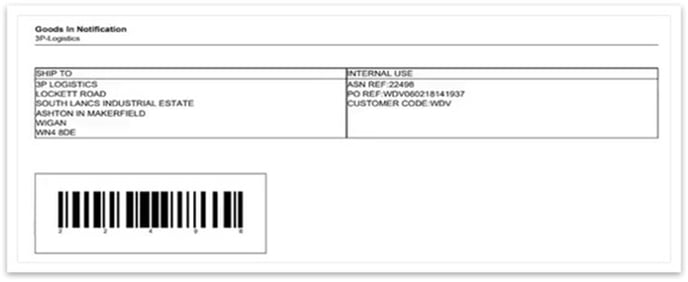
- For palletised deliveries, each individual pallet requires a pallet manifest detailing the goods and quantities within.
- This should be applied to each pallet. If loose loaded, then this should be applied to each individual carton.
- All deliveries, including container loads MUST arrive with the relevant paperwork (PO/ASN) and be presented by the delivery driver.
- Creating an inbound booking – Requesting a time to deliver the goods in.
Deliveries in to 3PL should not be made, unless both stages have been completed. Failure to complete these stages may result in one or more of the below:
- Refusal of delivery
- Additional charges applied
- Longer processing time / Devoid of SLA
Create Goods-In Notification
A Goods-In notification should be created every time the client wants to send goods inwards. The notification is simply a packing list of what goods will be contained within the inward consignment. Creating a Goods-In notification via Fusion is simple and can be done by building it one item at a time, or, via a bulk upload using a downloadable template which is available in Fusion. Please see below links to fusion
Creating GRN Manually - https://fusion.3p-logistics.co.uk/grn/create
Creating GRN In Bulk - https://fusion.3p-logistics.co.uk/grn/create/bulk
There is a reference field to be populated within Fusion when creating the Goods-In notification. This reference field should be populated with a reference that can be found on the paperwork, that will accompany the delivery.
When creating the Goods-In notification on Fusion, you will be presented delivery paperwork which we will create on your behalf. This should be attached to the inbound delivery.
Inbound Bookings
- The client should create a booking via Fusion to let the company know when the goods are going to arrive, as this allows 3PL to ensure adequate resource is on site to process the delivery.
- Each delivery should have 1 ASN (Goods In notification) created within Fusion.
- Deliveries should not contain multiple ASNs.
- Each delivery should have the correct ASN reference inbound paperwork accompanying each load.
- All deliveries will be subject to refusal if they are deemed to be unsafe (i.e. loaded in an unsafe manner). All loads will be inspected by senior goods in supervisors before a decision is reached.
- 3PL should be contacted on 01942 720 077 to be informed of any potential delays – traffic, poor weather etc. Provisions can then be made to re-arrange delivery times if required.
- All keys must be handed to goods-in staff when unloading is taking place.
- 3PL have the right to refuse any delivery if it is late i.e. more than 1 hour and misses its allocated booking slot with relevant missed booking surcharges applied.
- Vehicles / drivers will NOT be allowed on site before 7am.
- Vehicles / drivers will NOT be allowed to take rest breaks on site.
- No overnight parking will be allowed.
- On site speed limits must be adhered to.
- Drivers must wear appropriate PPE when on site – safety footwear / hi- viz clothing.
FHDDS
To ensure full compliance with UK legislation, specifically the HMRC FHDDS (Fulfilment House Due Diligence Scheme), it is imperative that we collect and document all Movement Reference Number (MRN) numbers for every import transaction. These MRN numbers play a crucial role in facilitating smooth and legally compliant import procedures. By providing us with all MRN numbers associated with your imports, you not only contribute to our adherence to regulatory requirements but also help streamline our operations for your benefit.
All import documentation needs to be provided upon creating an inbound booking and sent over to our Customer Services Team : Support@3P-Logistics.co.uk
Without the provision of the MRN, we are unable to process any inbound deliveries and all goods will be stored in a quarantined area upon arrival.
A daily fee of £500 will incur until the required MRN documentation is provided.
We appreciate your understanding and cooperation in adhering to these guidelines.
If you require any assistance or further information regarding this matter, please feel free to reach out to our Customer Services team.
Palletised deliveries including Containers
Palletised deliveries should be as per below:
- Cartons must be stabilised on the pallet, and to the pallet, to prevent movement or damage in transit. The preferred method is shrink or stretch wrapping (2 layers). Strapping must not be used.
- Different SKU’s must be presented on separate pallets – preferably no mixed pallets.
- Suppliers wishing to deliver mixed pallets, when they have SKU quantities that are less than a pallet layer, may include no more than TWO MIXED PALLETS PER TRAILER LOAD. When booking the delivery with Goods In suppliers must clearly indicate the number of mixed pallets in the delivery.
- When delivering a mixed pallet the pallet label must state, clearly, that it is a MIXED PALLET and indicate the quantities of cartons for each SKU on the pallet.
- All pallets should be numbered – e.g. pallet 1 of 20, pallet 2 of 20, etc.
- All pallets should have a separate packing list of goods attached to the pallet.
- All deliveries must have detailed packing lists / ASN’s.
- Vehicle delivering the load should be able to be unloaded from the rear on a dock leveller.
Pallet Labelling
- Ensure all pallets have a standard pallet label (see below) attached to them to avoid unnecessary delays in receiving the goods at the DC.
- Deliveries may be rejected without the correct labelling.
- All cartons stacked on the delivered pallets must, wherever possible, have the labels facing out to facilitate Goods-In inspection and bar code scanning the DC.
Pallet Label Format
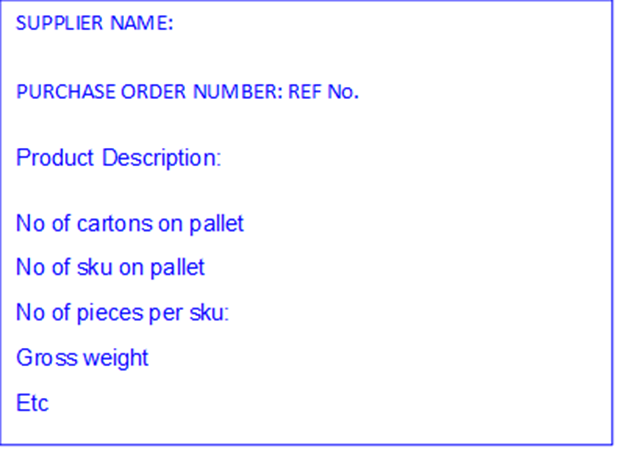
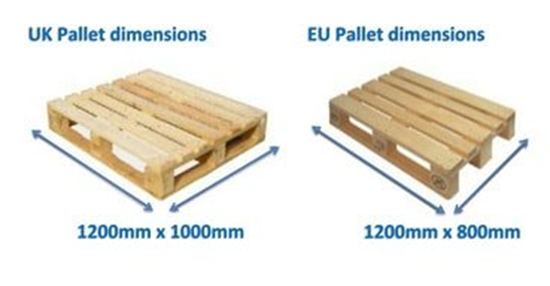
- Pallets should be 4-way Euro Pallets 1000mm x 800mm or Standard wooden pallets 1200mm x 1000mm, fully intact (no broken/cracked panel(s). (Fig 1)
Fig 1 – Pallet type(s) Euro / standard
- No USA skids.
- No cardboard or plastic pallets
- Pallets should be no more than 1.6m high (including pallet) Fig 2
Fig 2 – Max pallet height
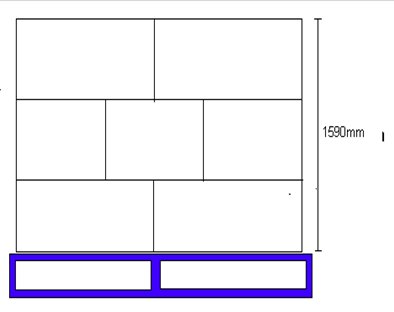
- All pallets should be clearly labelled with the relevant Goods in Reference number.
- All pallets should be securely and safely wrapped.
- Pallets should not exceed 1 metric tonne.
- Pallets that exceed 500kg must be securely strapped.
- Goods should be stacked safely and within the constraints of the pallet footprint – no overhang. (fig;1)
- Double stacked pallets should be avoided.
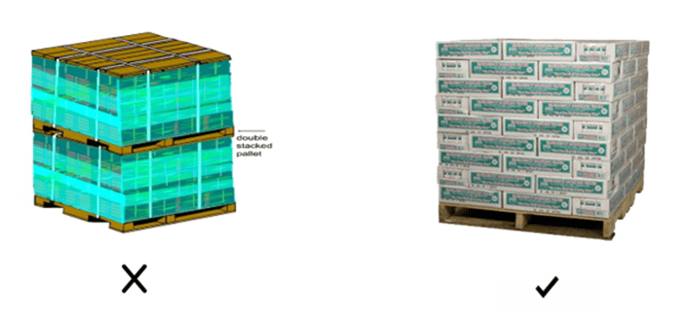
Fig 1 Pallet Overhang
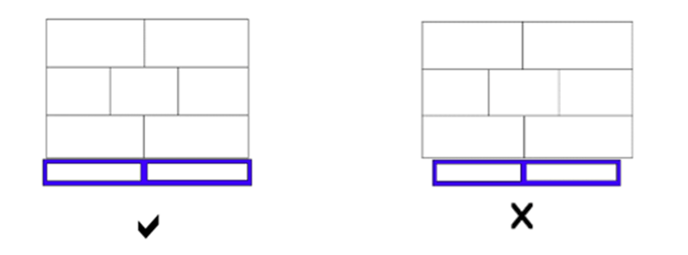
Failure to follow these compliance requirements may incur additional charges, void of SLA or refusal of the load.
Loose Loaded Container Deliveries
Loose Loaded container deliveries should be as per the below.
- Containers are required to be booked in a minimum of 5 working days in advance of arrival via Fusion.
- Containers should arrive sealed with the delivery paperwork detailing the same reference as per the inbound booking on Fusion.
- The driver should have copies of all corresponding paperwork.
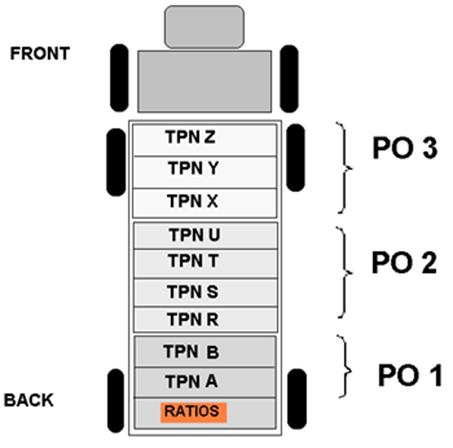
- Containers should be snake loaded with identical SKUs grouped accordingly. (fig;1)
- Same day cancellations will incur relevant cancellation charges. See Additional charges section.
- Containers comprising of greater than 600 cartons per 20ft equivalent may incur additional charges due to it taking longer to unload. In such instances, extended container rental should be obtained to avoid any additional charges from your hauler. 3PL is not liable for any additional charges incurred.
Delivery Loading Sequence
Each delivery must be arranged into the correct order at the dispatch dock such that:
- Vehicles or container can be loaded in the correct sequence.
- the goods can then be unloaded in the correct sequence at 3PL distribution centre.
1) When loading you MUST NOT mix:
- Purchase Orders
- Sku’s
THIS IS A REQUIREMENT FOR TRAILERS AND CONTAINERS
Fig ;1 – Snake load Note – TPN = Sku
Safety
If at any time the fire alarm is activated on site, drivers will be asked to leave their vehicles and report to the fire assembly point on site (Supervisors will direct). This is to protect them from any possible hazards. They will be informed when the “all clear” is received.
- Smoking is NOT permitted on site, except in designated areas only. (This includes in drivers cabs).
- If the fire alarm is activated, please refrain from any vehicle movement around the buildings.
- High Viz clothing and safety footwear should be always worn, when on site.
- Drivers will not be permitted to enter the warehouse without being accompanied by a 3PL member of staff.
3PL operate a zero-tolerance policy in relation to threatening or unprofessional behaviour.

Additional Charges
Please see below table of additional charges which may be applied in relation to non-conformance during the inbound procedure.
|
Title |
Description |
Charge |
|
Non-Barcoded Item |
Charge for re-labelling of item |
As Per Rate Card |
|
Non-Packaged Item |
Charge for individually bagging and labelling Based on a clear bag 35cmx43cm |
£0.35 Per Item |
|
Non-Arrival |
Surcharge for non-delivery of pre booked container delivery |
Container Unloading Charge as Per Rate Card |
|
Non-Booked |
Charge for unloading a non-booked container |
£500 |
|
Same Day Cancellation |
Charge for cancelling a container without a minimum of 24 hours’ notice |
50% of tariff as per rate card |
|
Late Container |
Surcharge for containers arriving greater than 1 hour outside of their pre agreed booking slot |
£150 Per Hour Late |
|
Container Handling Non-Conformance |
Incorrect GRN Multiple GRNs on single delivery Non-Snake Loaded Shot Load |
£100 per instance |
|
Incorrect Pallet Specification |
Pallet Received not as per required specification |
£50 Per Pallet |
All information / charges within this document are subject to regular review and can be changed at any time.